
Climbing stairs throughout the day
1. Why is climbing stairs good for you?
Desk jobs push human bodies into static, folded positions for eight hours a day. That prolonged immobility turns off your posterior chain, slows metabolic throughput, and flattens cardiorespiratory output.
You don't need a dedicated gym block or specialised gear to fight back. The office stairwell is essentially a pre-installed vertical training rig. Stair climbing is a fundamental, multi-joint functional movement: it demands unilateral hip and knee extension, dynamic balance, and continuous core stability. Stepping off the elevator grid for brief, deliberate climbs recharges your systemic engine, sends fresh oxygen to brain tissue, and breaks the postural slouch before it takes hold.

2. What are the health benefits?
These aren't hypothetical gains. Research consistently shows that brief, intense bursts of vertical locomotion—often called "exercise snacks"—deliver metabolic and cardiovascular adaptations comparable to longer, traditional cardio sessions.
Cardio Fitness & Power Output
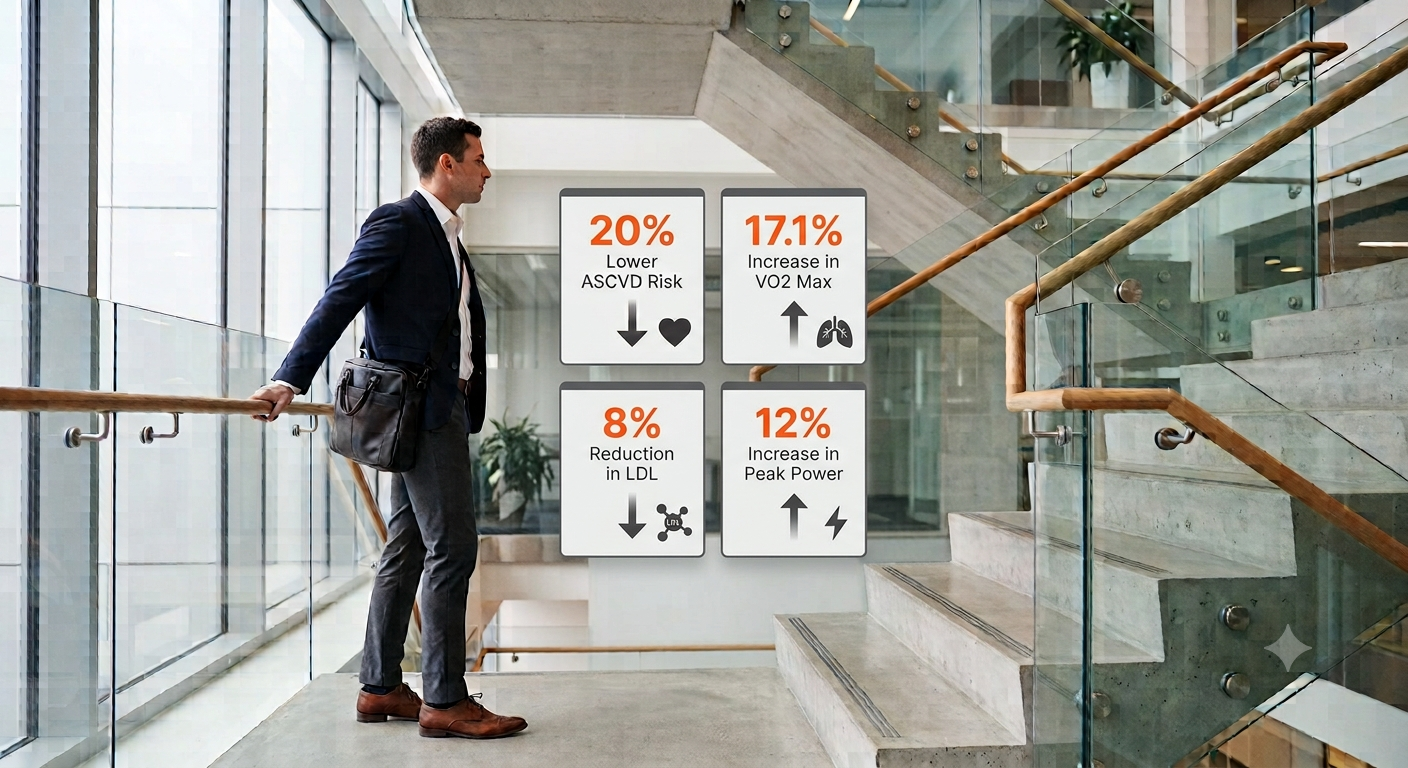
Substantial VO2 Max Gains: A seminal 8-week intervention by Boreham et al., published in the British Journal of Sports Medicine, tracked previously sedentary adults who accumulated short bouts of stair climbing throughout the day. The result: a 17.1% jump in VO2 max along with an 8% drop in low-density lipoprotein (LDL) cholesterol.
The "Exercise Snack" Proof: A study from McMaster University published in Applied Physiology, Nutrition, and Metabolism evaluated individuals taking three 60-step stair breaks a day (spaced 1 to 4 hours apart), 3 days per week. Over 6 weeks, participants saw a 5% increase in VO2 peak and a 12% improvement in peak cycling power—proving you don't need to sweat through a 45-minute class to build engine capacity.
Longevity & Heart Health
Reduce cardio vascular disease risk: A 2023 study from Tulane University published in Atherosclerosis analyzed data from over 450,000 adults across a 12.5-year follow-up. Researchers found that climbing at least 5 flights of stairs daily (roughly 50 steps) reduced the risk of atherosclerotic cardiovascular disease (ASCVD) by 20%.
Long-Term Survival: Classic findings from the Harvard Alumni Health Study tracked thousands of men over decades. Those who habitually climbed 35 or more flights of stairs per week demonstrated an 18% to 22% lower risk of all-cause mortality compared to those who rarely took the stairs.
Metabolic Rate: Stair climbing registers between 8 and 11 METs (Metabolic Equivalents), burning about 8 to 11 calories per minute—roughly 8 to 10 times the energy burn of sitting at your workstation.
3. Form for climbing stairs
Moving fast with poor form just builds bad habits. To protect your knees and lower back while getting maximum glute and hamstring recruitment, lock in these movement standards on every single step.
The Setup & Spine
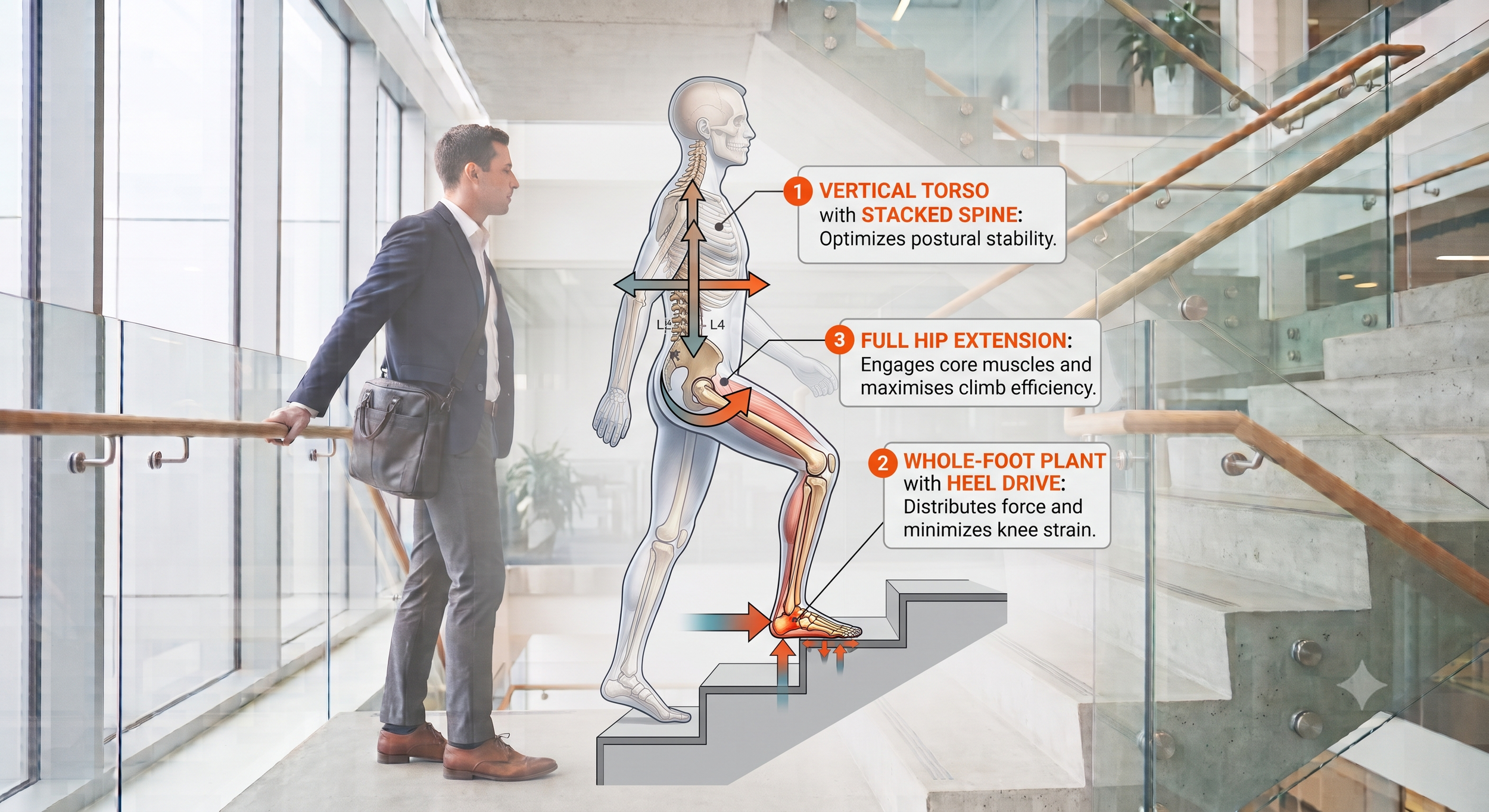
Eyes Up, Torso Tall: Stand upright. Keep your eyes looking 3 to 4 steps ahead—don't stare down at your toes, which pulls your head forward and rounds your upper back.
Brace the Core: Flex your abs slightly as if you're preparing for a light squat. Keep your shoulders down and back, away from your ears.
The Ascent (Drive Phase)
Plant the Whole Foot: Place your entire foot flat on the stair tread. Letting your heels hang off the edge shifts all the load straight into your calves and Achilles tendons.
Drive Through the Heel: Push through your mid-foot and heel to fire your glutes and hamstrings. If you push exclusively off your toes, your quads and patellar tendons take all the strain.
Finish the Extension: Stand all the way up on the lead leg before stepping through to the next stair. Get full knee and hip extension at the top of the stride.
Track the Knee: Make sure your knee stays aligned over your second and third toes during the push. Don't let your knee cave inward (valgus collapse).
The Descent (Controlled Lowering)
Use Muscle, Not Joints: Descending puts an eccentric load on your quads. Keep a subtle bend in your knees so your muscles absorb the impact, rather than letting your joints take the pounding.
Soft Footfalls: Land quietly on the mid-foot, maintaining a tight core and balanced weight distribution.
4. Common mistakes
5. Incorporate into the workday "Exercise Snack"
You don't need to change into gym clothes to make this work. Treat stair climbing like short, crisp skill practice throughout the day.
The 3x3 Daily Stair Snack
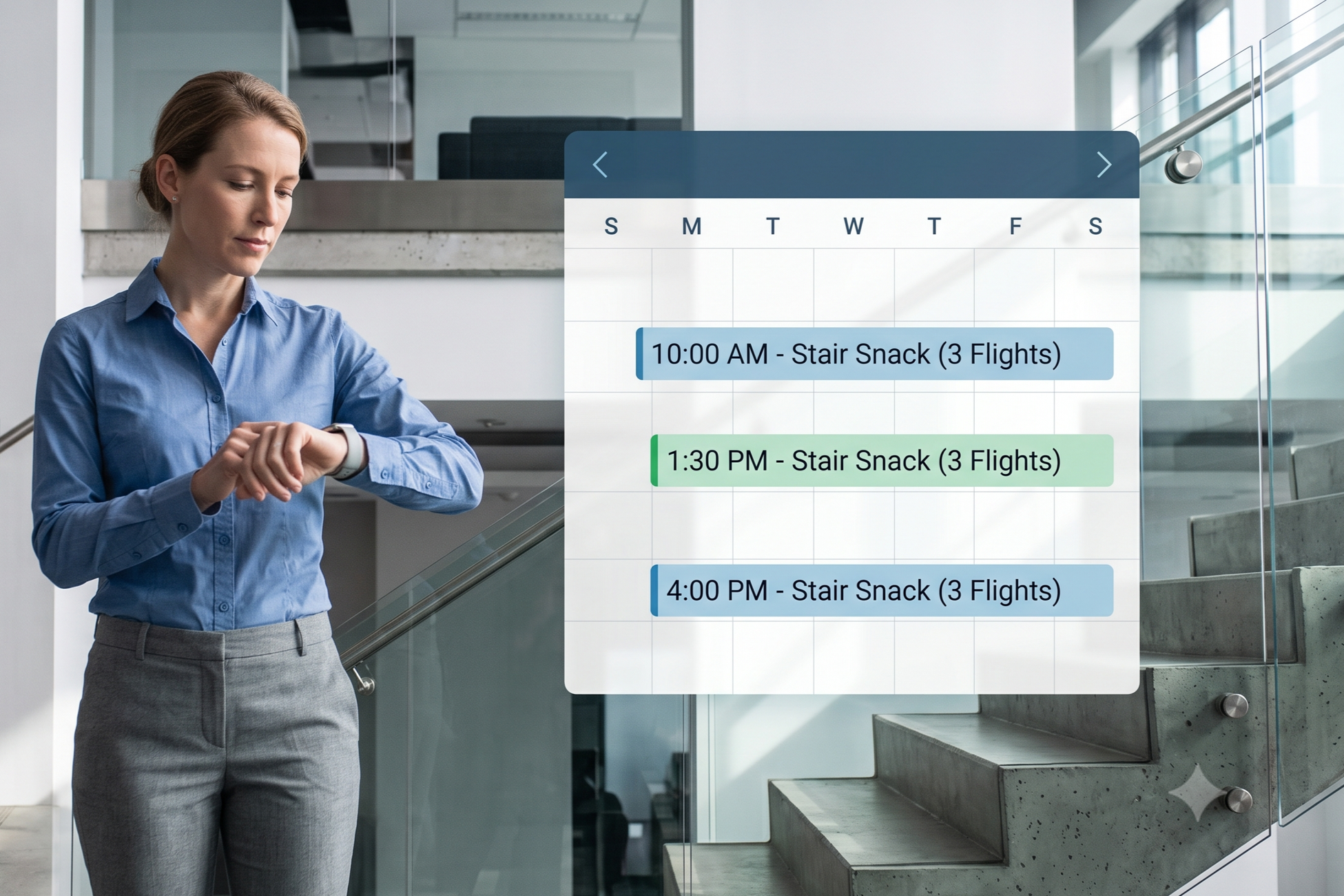
Frequency: 3 sessions spaced across your workday (e.g., 10:00 AM, 1:30 PM, 4:00 PM).
Volume: 3 continuous flights per session (roughly 50 to 60 total steps).
Intensity: Brisk and intentional, but controlled (RPE 7 out of 10). You should be breathing heavily, but able to speak a sentence.
Rest: At least 1 to 4 hours between bouts.
Goal: Flawless mechanics on step 60 just as on step 1.