
Air squats during the work day
What Is an Air Squat?
The air squat is the essential human movement pattern. It requires no barbell, no equipment, and no external resistance—only your body weight moved through a full range of motion.
At its core, the squat is the functional utility of moving your hips from a standing position to a point below your knees and returning to full extension. It is not merely an exercise; it is an foundational human capacity. Mastering the air squat builds the structural foundation for all lower-body power, spinal stability, and long-term joint health.
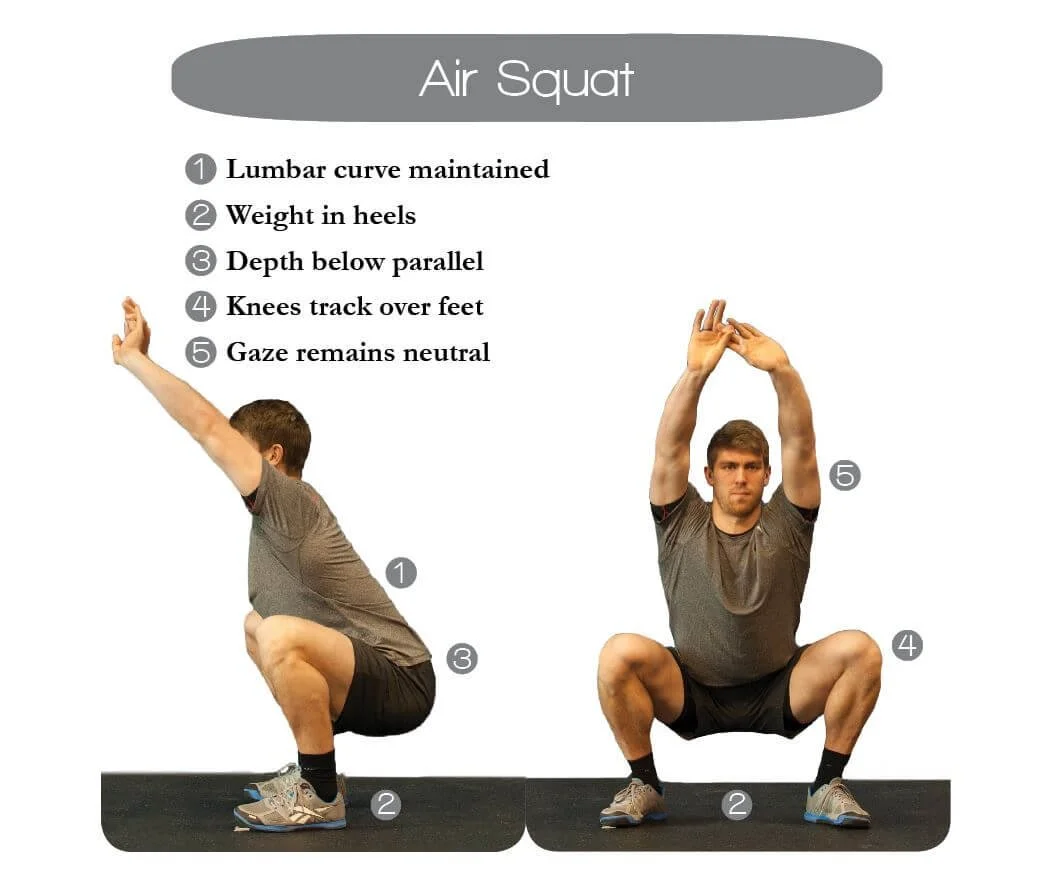
Points of Performance: Air Squat Mechanics. Source: Journal Menu
Points of Performance: Execution & Form
To extract maximum metabolic efficiency and protect the spine, execution must remain pristine.
Setup
Stance: Shoulder-width, with toes pointed slightly outward (roughly 15 to 30 degrees).
Posture: Chest up, eyes straight ahead, lumbar curve locked in tight.
Balance: Weight distributed evenly across the tripod of the foot (heel, big toe, little toe), leaning toward the heels.
Execution
Initiate with the Hips: Begin the movement by sending your hips back and down—do not break at the knees first.
Knees Out: Drive your knees outward in line with your toes throughout the descent. Never let them collapse inward (valgus twitch).
Depth: Lower your hips until the crease of your hip drops clearly below the top of your kneecap (below parallel).
Torso: Keep your chest lifted and your arms raised as needed to maintain a neutral spine.
Drive: Push through the middle of the foot and heels, extending hips and knees simultaneously until you reach full extension at the top.
The Physiology of Sitting: Why Movement Snacks Matter
Modern corporate environments are engineered for immobility. Desk work forces prolonged hip flexion and muscular dormancy, fundamentally degrading human health and cognitive output.
As fitness pioneer Greg Glassman noted when establishing foundational movement methodology, functional movements move large loads over long distances, quickly. When translated to bodyweight movement, the air squat recruits the largest muscle groups in the human body—the glutes, quadriceps, and hamstrings—creating a systemic neuromuscular stimulus.
"The squat is essential to human health, performance, and independence. It is built into our DNA."
— Greg Glassman, Founder of CrossFit
Health & Productivity Benefits: The Data
Integrating brief "exercise snacks"—short bouts of movement like 1 to 3 minutes of bodyweight squats—directly counteracts workplace sedentary decline.
1. Metabolic Clearance & Blood Sugar Control
Prolonged sitting shuts down muscular contraction, reducing muscle glucose uptake. Performing bodyweight squats at regular intervals forces large muscle beds to clear blood glucose without relying solely on elevated insulin levels.
The Evidence: A randomized crossover trial published in the Journal of Applied Physiology demonstrated that taking 3-minute squat breaks every 45 minutes across an 8.5-hour workday reduced post-meal glucose exposure by 22.5% compared to uninterrupted sitting.
2. Cognitive Performance & Focus
Physical movement increases cerebral blood flow, triggering the release of Neurotrophic factors such as BDNF (Brain-Derived Neurotrophic Factor), which sharpens executive function, memory, and task switching.
The Evidence: Research on workplace-integrated "exercise snacks" published via the National Institutes of Health (PMC) showed that brief, vigorous movement breaks yielded immediate, statistically significant improvements in processing speed and executive control (measured via Stroop Color-Word and Trail Making tests).
Source: Workplace-Integrated Exercise Snacks Study (PMC12197268)
3. Fatigue Reduction & Workplace Morale
Stepping away from the monitor to execute air squats interrupts mental monotony, increases oxygen delivery, and dampens the physiological fatigue curve.
The Evidence: Large-scale workplace movement trials led by Dr. Keith Diaz (Associate Professor of Behavioral Medicine at Columbia University) found that taking 5-minute movement breaks during the workday reduced participant fatigue by approximately 25%, alongside significant reductions in bad mood markers and increases in self-reported engagement.