
Floor sitting at work
Modern office culture has bound us to standard desk chairs for 8+ hours a day. Biomechanically, this casts our bodies into fixed 90-degree hips and knees—a position physical therapist Dr Kelly Starrett, co-author of Built to Move and Deskbound, calls a primary driver of functional movement breakdown.
Sitting in a standard ergonomic chair is passive; it turns off your core and shortens your hip flexors. By contrast, moving down to a floor-seated position or low-desk setup forces dynamic posture adjustment.
Here is why spending 20–30 minutes a day working from the ground will protect your tissue quality, build trunk stability, and bulletproof your mobility.
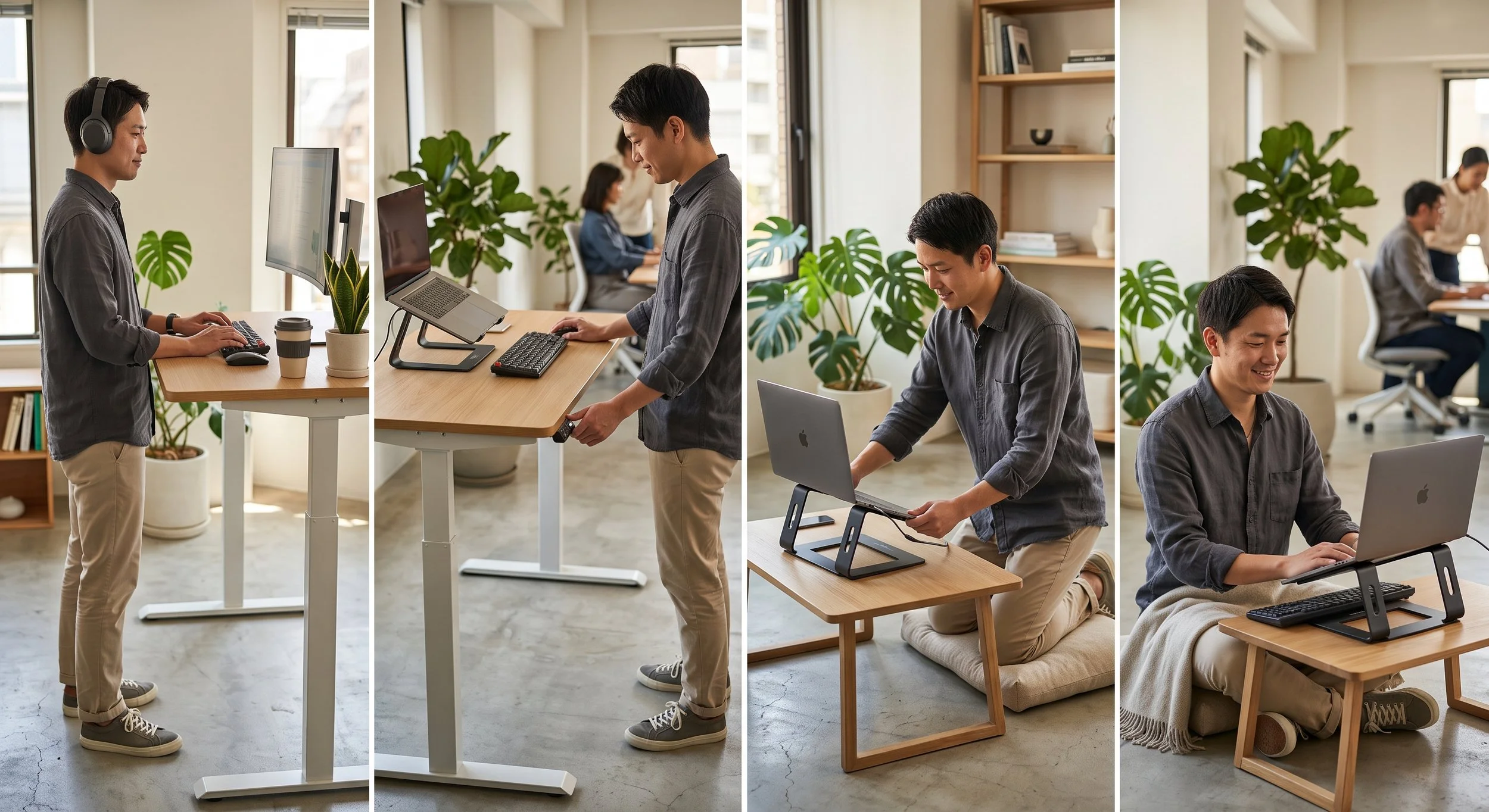
Why Floor Sitting Works
When you park your hips on a chair, your hamstrings, glutes, and spinal erectors disengage. The chair supports all your weight, allowing your deep core stabilisers to go completely dark.
Active Trunk Engagement
Sitting on the floor without a chair back requires continuous, low-grade muscle activation across your midsection and back. Research published via PMC measuring postural and spinal stability found that floor-seated postures (such as cross-legged or kneeling) significantly alter trunk muscle activation and demand active hip and spinal control to maintain balance. Biomechanical evaluations demonstrate that floor sitting can activate up to 40% more stabilising trunk musculature than standard chair sitting, reclaiming pelvic alignment that passive chairs destroy.
Restoring Hip Range of Motion
In a chair, your hips stay locked in sagittal alignment (flexed forward). Over time, you lose internal and external rotation. Transitioning down to the floor forces your hips through varied positions: cross-legged (external rotation), 90/90 (combined internal/external rotation), or kneeling (hip extension and ankle plantarflexion). Regular floor sitting practices can help increase functional hip mobility by up to 40%, helping relieve the tightness that directly pulls on the lumbar spine.
Metabolic & Circulation Benefits
Static sitting compresses the hamstrings and popliteal vessels, slowing venous return. Floor sitting promotes constant micro-adjustments—you shift, fidget, stretch, and change leg positions naturally. Electromyography (EMG) studies highlight that these dynamic postural shifts prevent muscle fatigue build-up and improve localized blood flow.
Floor Sitting Positions
Do not simply sit slumped on a hard floor for four hours. Treat floor work like a movement protocol: vary your positions every 10 to 15 minutes.
Tailor Sit (Cross-Legged)
Focus: Hip External Rotation & Pelvic Neutral
Sit tall on a firm cushion (3–5 cm thickness is optimal to prevent pelvic tucking). Cross your shins, press your seat bones down, and lengthen through the crown of your head.
Key Check: If your lower back rounds heavily, increase your cushion height.
The 90/90 Seated Shift
Focus: Hip Internal & External Rotation
Sit on the floor. Place your lead leg in front of you at a 90-degree angle (thigh straight out, shin perpendicular). Place your trail leg out to the side, also bent at 90 degrees. Keep your torso upright. Switch lead legs every 5–10 minutes.
Key Check: Dr Kelly Starrett highlights the 90/90 as one of the ultimate tests for rotational hip health—linger in the tight spots.
Tall Kneeling / Hero Pose
Focus: Quad Length & Ankle Mobility
Kneel on a yoga mat with your toes untucked (tops of feet flat) or tucked under. Sit back onto your heels or place a foam block between your feet.
Key Check: This opens up the front line of your thighs and hips while undoing shoe-bound ankle stiffness.
Long Sit (Straddle or Straight Leg)
Focus: Posterior Chain Mobilisation
Extend your legs straight out in front or in a slight straddle. Keep your chest elevated to avoid heavy lumbar flexion.
Key Check: Great position for typing or reading documents; forces your hamstring complex to lengthen.
Rules for the floor desk
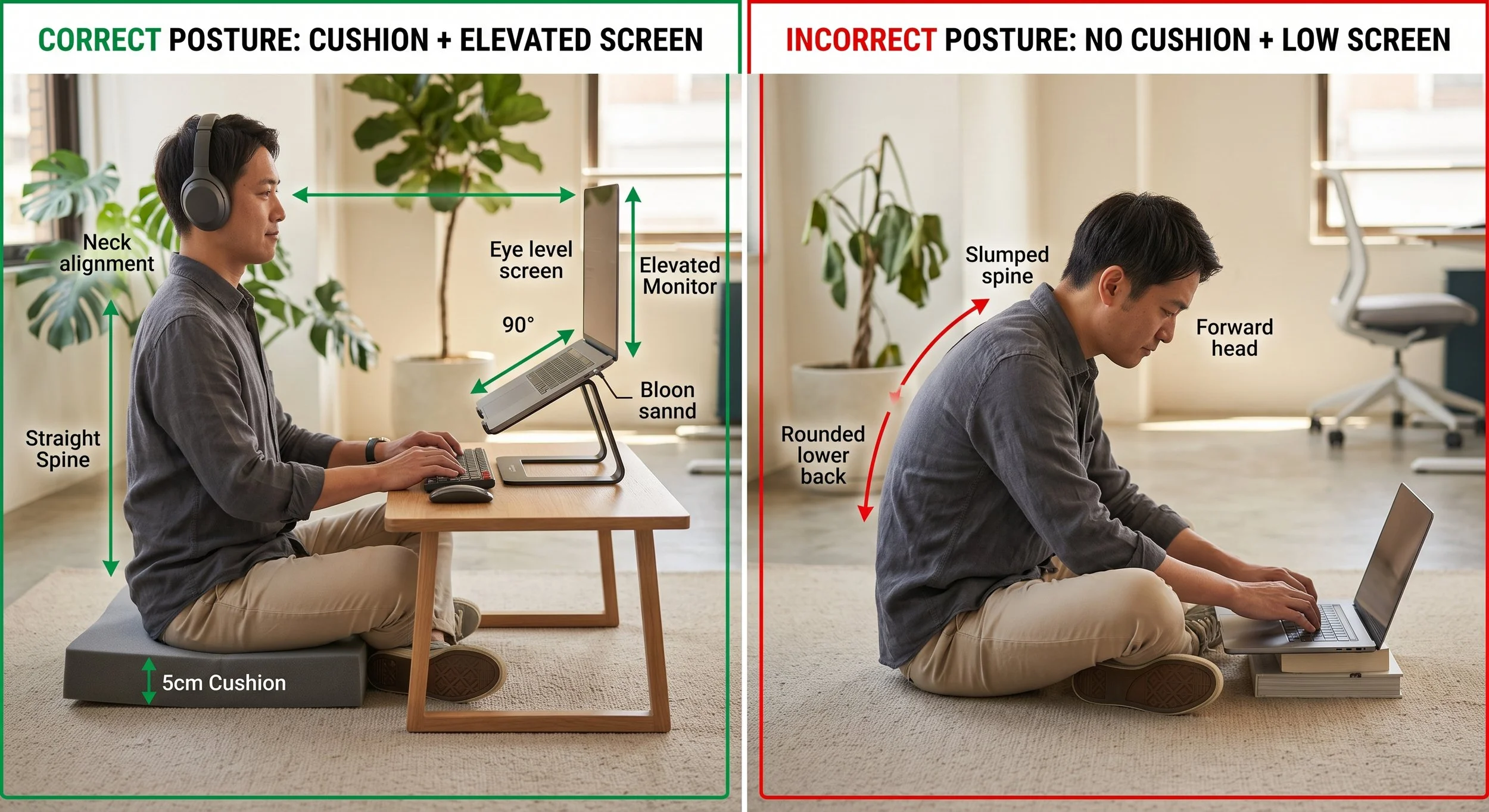
Moving to the floor does not mean throwing spinal mechanics out the window. If you sit on the floor and hunch down over a laptop on carpet, you swap hip tightness for severe neck strain.
Elevate the Screen: Use a laptop stand, low coffee table, or yoga blocks so the top of your monitor remains near eye level.
Support the Pelvis: As demonstrated in ergonomic floor-seating studies, unassisted floor sitting on hard surfaces increases lumbar disc pressure if you collapse. Use a dense 3–5 cm cushion under your sit bones to tilt your pelvis forward into natural lumbar lordosis.
Capsule Time Limit: Limit floor desk work to 20–45 minute intervals before standing up or returning to a traditional desk setup.
Further reading on this topic
Trunk Muscle Activation & Floor Stability: A comprehensive 2024 study published in PMC evaluated postural stability and muscle activity across Asian floor-sitting positions, establishing that firm floor cushions (3–5 cm) combined with kneeling and cross-legged positions reduced muscle fatigue while maintaining trunk stability compared to unsupported postures. Read the study: PMC Postural & Spinal Stability Analysis (2024)
Spinal Load & Postural Biomechanics: A 2023 study in Bioengineering (MDPI) mapped intradiscal pressure changes across sitting variations, proving that maintaining active posture/lumbar lordosis on the floor protects spinal discs from excess pressure compared to passive slumping. Read the study: MDPI Biomechanical Effects of Sitting Postures (2023)
Systemic Posture & Flexibility Improvements: Clinical evaluations by Upright Technologies showed that spending dedicated time in dynamic ground positions builds dormant stabilising muscles, yielding up to a 40% increase in hip range of motion and an 78% improvement in baseline posture measurements over 30 days. Read the analysis: Upright Health Floor Sitting Biomechanics Report