
Face-to-Face Connection: The Missing Variable in Workplace Health
We track screen time. We audit ergonomic chairs. We optimize daily workflows. Yet we continue to ignore the single most potent variable in human performance and stress management: direct, physical social interaction.
As modern workplaces trade brief, face-to-face check-ins for endless instant messages (IMs) and cold emails, we are witnessing a systemic decline in physiological and psychological resilience.
Sending an email might feel like a path of least resistance, but from a mechanical and physiological standpoint, digital text-based communication isolates workers. Real human connection, by contrast, activates a complex biological response system designed to reduce stress, elevate mood, and sharpen cognitive capacity.
Here is the science behind why stepping away from your keyboard to speak with a colleague face-to-face is vital for your health, performance, and long-term health span.
1. The Biology of Connection vs Digital Isolation
When you interact with a colleague in person, your body isn't just processing words. It is actively reading non-verbal cues—facial expressions, micro-movements, tone of voice, and eye contact.
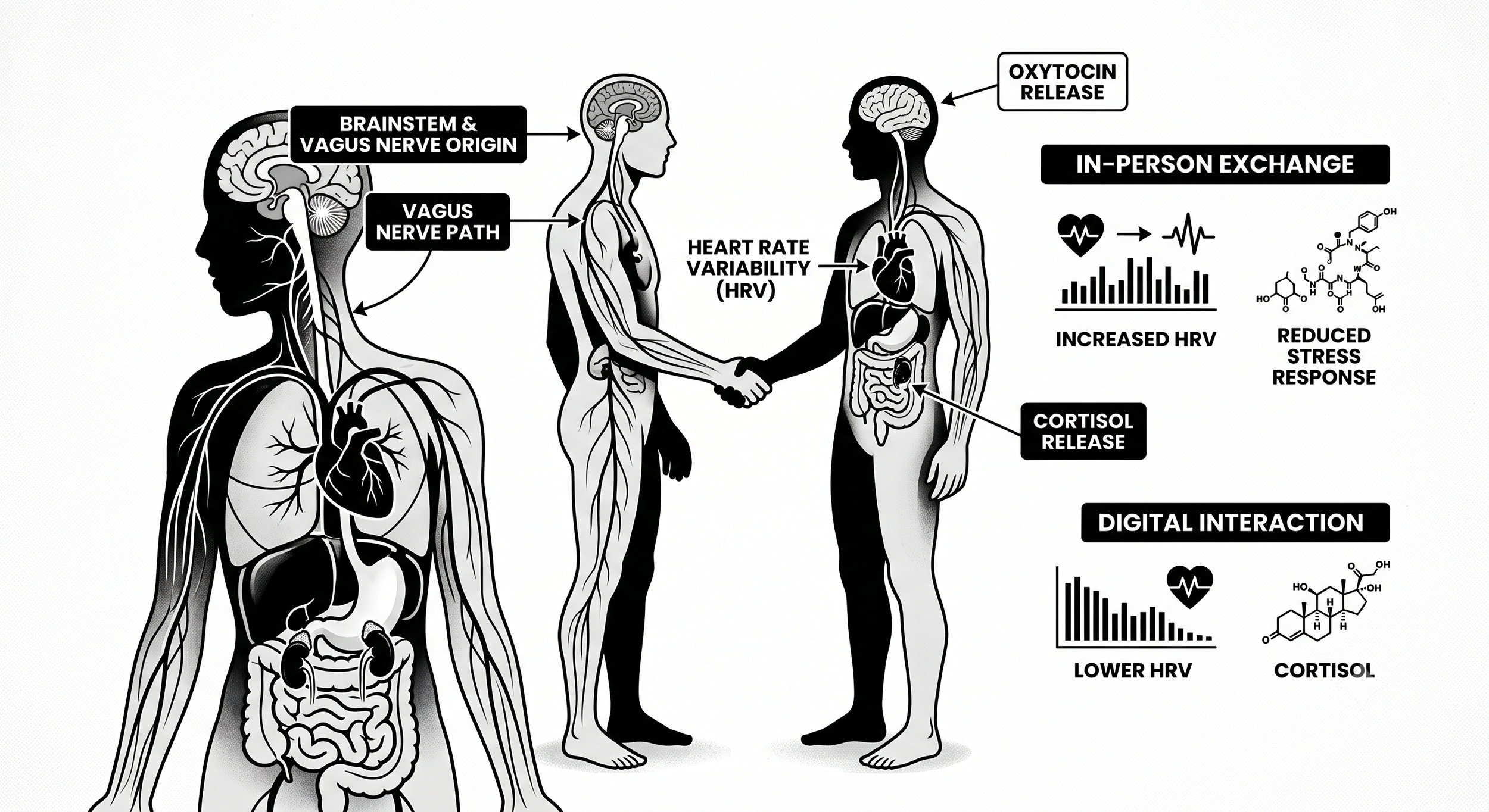
The Bio-Mechanical Shift — Face-to-Face interaction vs. Digital Isolation
The Chemical Shift
Oxytocin Release: Direct face-to-face contact triggers the release of oxytocin, a hormone that lowers blood pressure, reduces social anxiety, and promotes feelings of trust.
Cortisol Reduction: Asynchronous digital communications—such as endless email threads or urgent chat notifications—keep the sympathetic nervous system in a state of low-grade, chronic alert, driving up cortisol levels. In-person dialogue dampens this fight-or-flight response.
Neurological Co-Regulation: Human beings are wired for visual and acoustic co-regulation. Seeing a physical human being provides instant emotional feedback that text on a screen simply cannot replicate.
The Longevity Effect: A landmark meta-analysis conducted by Dr Julianne Holt-Lunstad et al. (Brigham Young University) revealed that individuals with strong social relationships have a 50% greater likelihood of survival over a given period compared to those with insufficient social connections. The mortality risk of social isolation was found to be comparable to smoking 15 cigarettes a day and greater than physical inactivity or obesity.
2. Friction vs Flow: The Communication Mechanics
Relying entirely on text messaging for workplace collaboration creates cognitive friction. Text lacks context, tone, and empathy, leaving the brain to constantly fill in the blanks—often with negative assumptions.
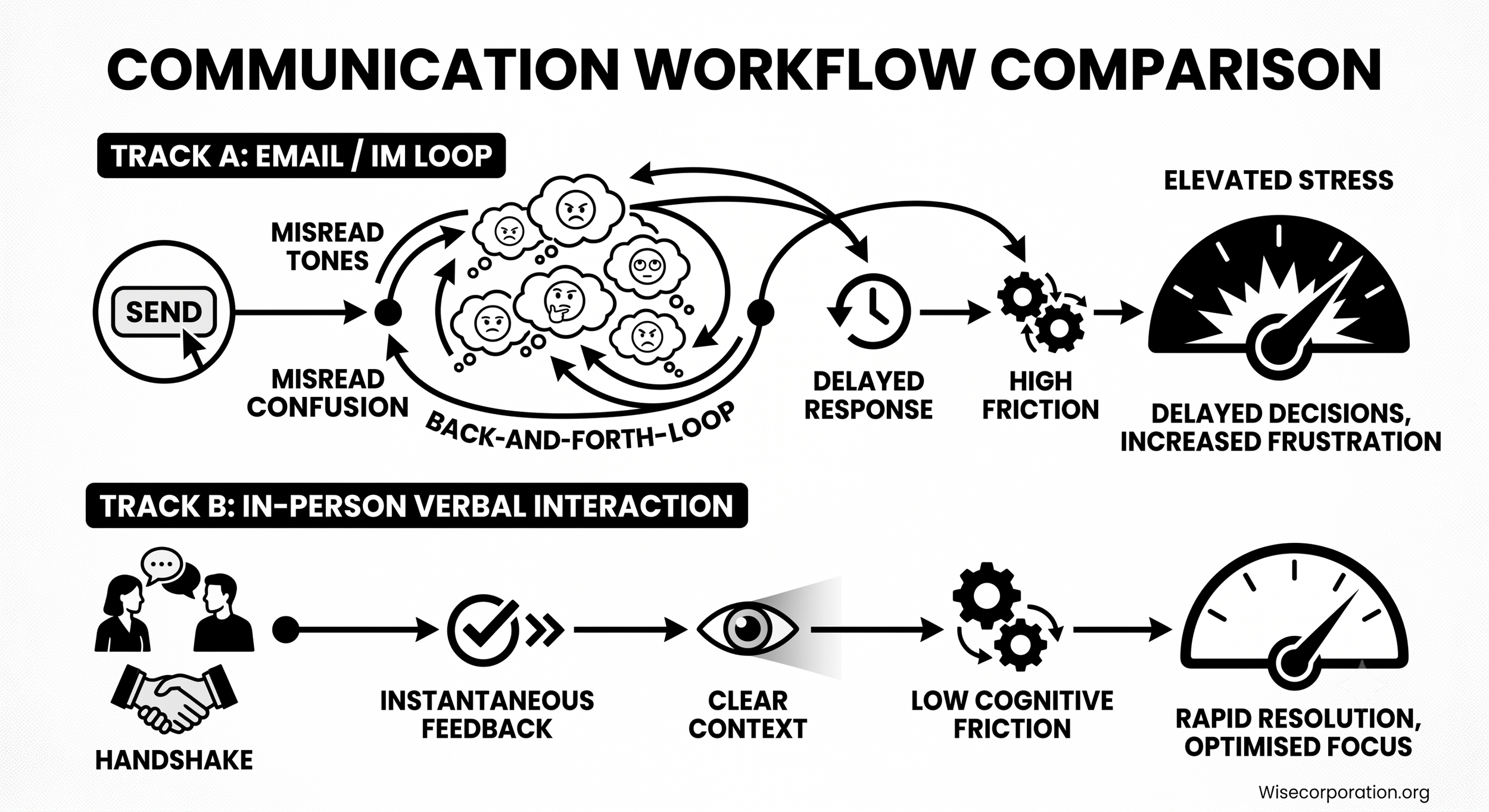
The Communication Efficiency Vector.
The Persuasion Gap
We frequently overestimate the power of text over a screen. Research published in the Journal of Experimental Social Psychology by Dr Vanessa Bohns (and reported by Harvard Business Review) demonstrates that a face-to-face request is up to 34 times more effective than an email.
Text leads to misalignment and misinterpretation. Physical interaction delivers real-time feedback loops, allowing teams to resolve complex problems quickly while building interpersonal trust.
3. Workplace Cohesion and Performance
When employees operate in digital silos, team dynamics degrade. Work becomes transactional, leading to elevated burnout and reduced innovation.

Collaborative feedback loops in active workplace environments.
The MIT Media Lab Data
In studies conducted by Dr Alex "Sandy" Pentland at the MIT Media Lab, researchers monitored workplace interaction patterns using badges. The findings revealed that informal, face-to-face communication was the single most important predictor of a team’s success, accounting for up to 35% of the variance in performance between teams.
When individuals physically talk, share space, and engage in informal conversations—such as brief, unstructured chats in shared spaces—team cohesion and individual stress resilience increase significantly.
Best Practices for Workplace Interaction
Just as we teach proper form for physical movements, we must establish mechanical standards for functional daily interaction. Follow these best-practice guidelines to improve communication health:
1. The "Two-Touch" Rule
If an issue requires more than two email or chat exchanges to clarify, stop typing. Stand up, walk to your colleague’s desk, or meet in a common area to resolve it in person.
2. Prioritise Human Onboarding
Begin key projects or welcome new team members with in-person meetings. Establishing strong initial social connections sets a foundation of trust that makes future remote or text communication smoother and less stressful.
3. Incorporate Walking Meetings
Combine physical movement with social connection. Taking a 10-minute walking meeting outdoors delivers a double dividend: light aerobic activity coupled with face-to-face co-regulation.
4. Respect the Shift
Acknowledge when text is appropriate (routine status updates, structured logs, brief data points) versus when in-person interaction is vital (feedback, strategic alignment, conflict resolution, sensitive discussions).
Summary
Sending a message is easy; building authentic human connection takes effort. However, relying on digital text to replace face-to-face interaction comes at a cost to physiological health, team resilience, and overall clarity.
To optimise your workplace health, treat social interaction like any key component of your physical regimen: execute it with intent, maintain high standards, and prioritise real human connection over digital convenience.