
Early morning daylight exposure
HOW DAYLIGHT DRIVES PERFORMANCE
Think of your body as a finely tuned machine. Just as a barbell requires clean mechanics to lift efficiently, your internal biology requires precise environmental cues to run at peak capacity.
Inside your brain sits a cluster of roughly 20,000 nerve cells called the Suprachiasmatic Nucleus (SCN). Located in the hypothalamus, the SCN is your Master Clock. It dictates when you wake, when you produce power, when your digestive system processes fuel, and when your body shifts into deep repair mode.
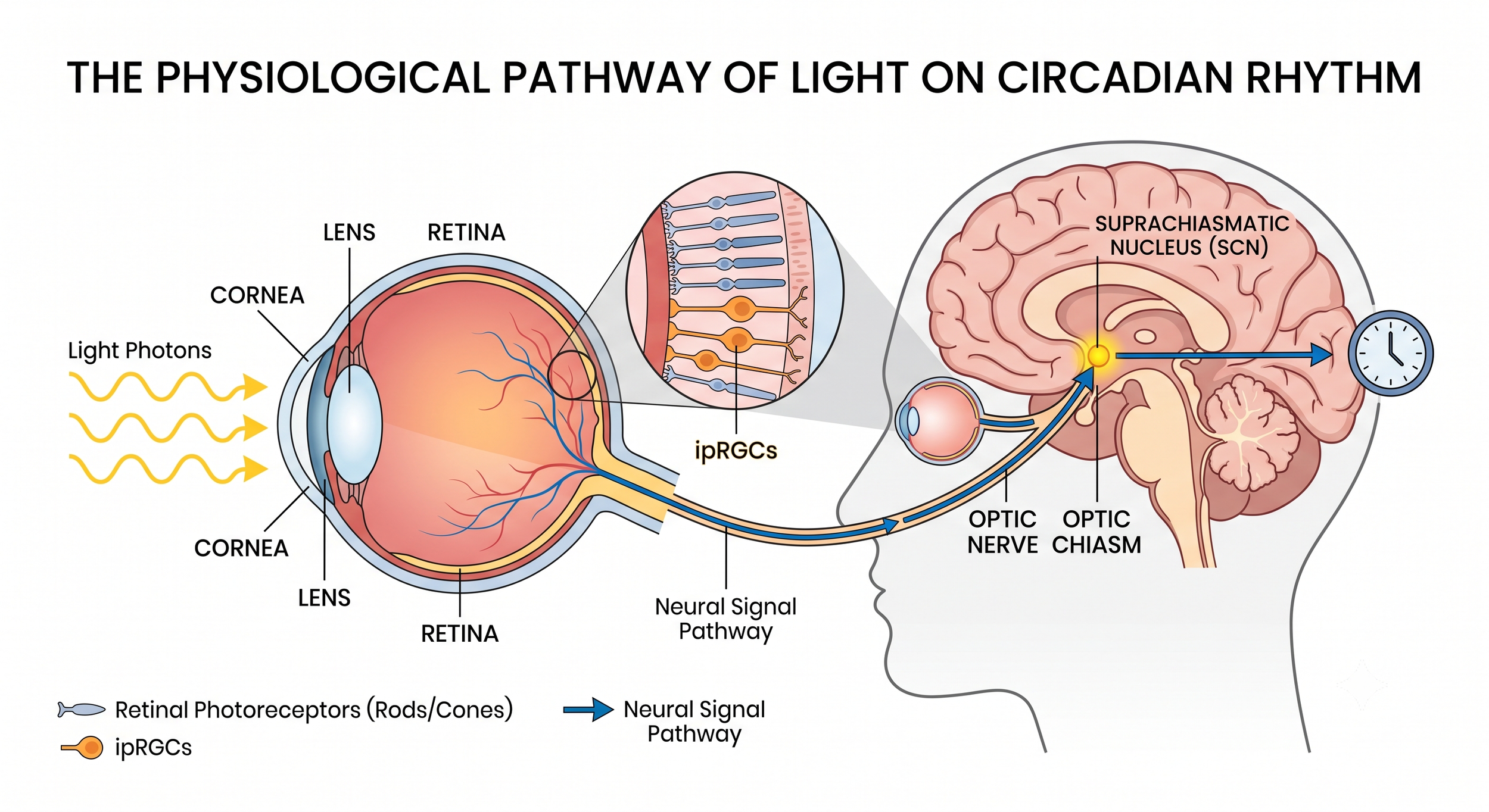
The direct neural pathway from ocular photon hit to Central Biological Command.
Here is how the system fires:
The Sensors (ipRGCs): Specialised neural cells in your lower retina—called intrinsically photosensitive retinal ganglion cells—are specifically sensitive to blue-wavelength photons found in morning daylight.
The Ignition Signal (Cortisol Pulse): When photons hit these sensors early in the day, your SCN triggers an immediate, healthy spike in cortisol. This isn't "stress" cortisol—it is your natural biological ignition switch. It sets your immune function, boosts body temperature, and sharpens cognitive focus.
The Sleep Timer (Melatonin Suppression): Daylight exposure immediately suppresses melatonin (the sleep hormone). More importantly, it starts a 12- to 14-hour countdown timer in your brain. The brightness of your morning light directly determines how effectively melatonin will be released later tonight.
As Dr Andrew Huberman (Professor of Neurobiology at Stanford University School of Medicine) states: "Getting sunlight in your eyes early in the day is the single most powerful stimulus for alertness during the day and sleep quality at night."
2. THE HARD DATA: WHAT THE RESEARCH PROVES
We do not program training based on guesswork; we use hard numbers. The peer-reviewed science behind morning light exposure shows dramatic measurable shifts in human performance:
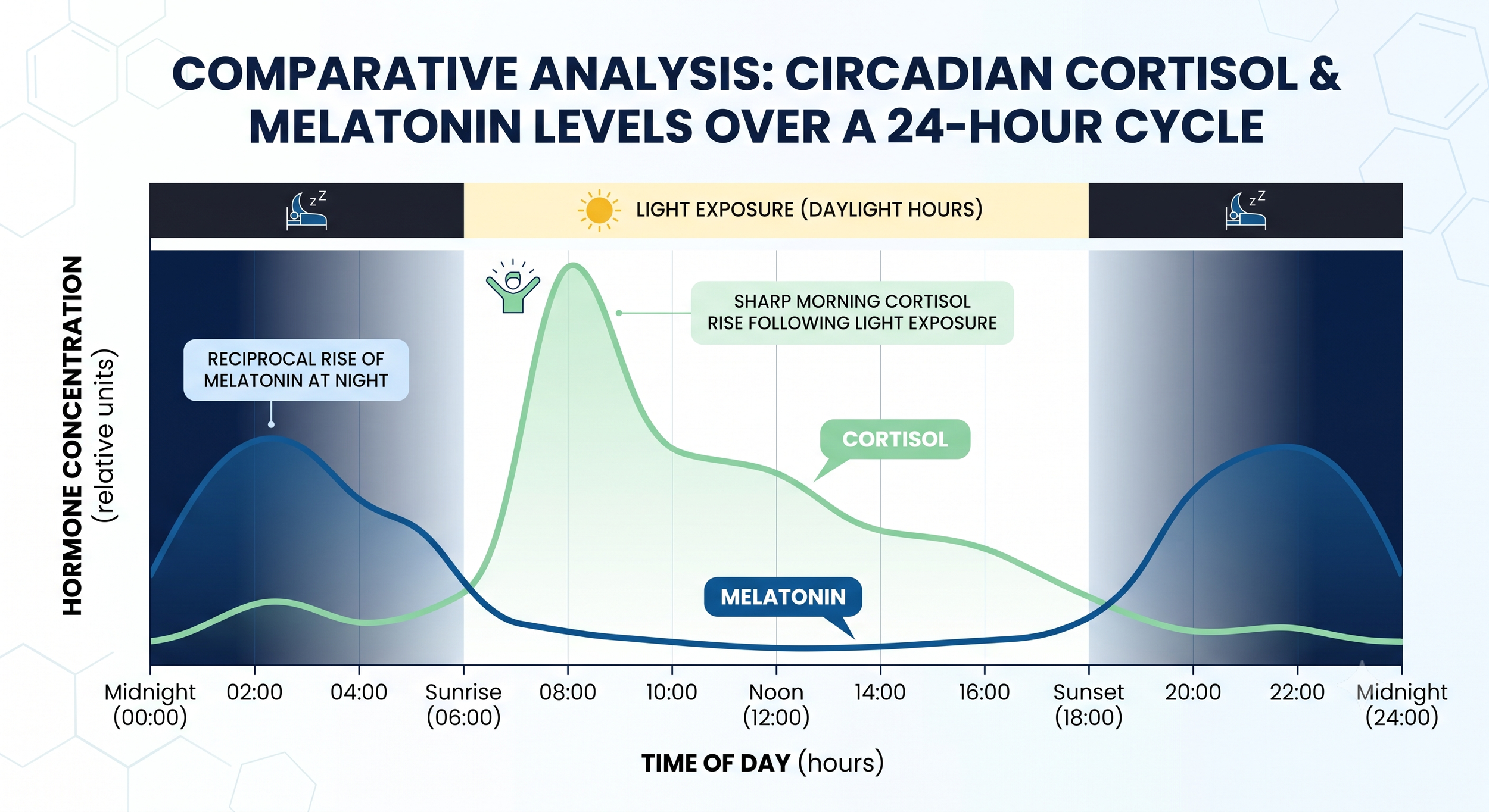
Hormonal alignment resulting from consistent morning photon exposure.
A. Sleep Efficiency & Latency
A field intervention published in the Journal of Sleep Research demonstrated that individuals receiving high morning light exposure achieved significantly higher sleep efficiency (83.82% vs 80.35%, p=0.02) and lower sleep fragmentation (15.26% vs 17.18%, p=0.05) compared to those under standard office lighting. They also fell asleep faster and experienced lower next-morning sleep inertia.
Research published via PubMed / Nature tracking adult light logging established that higher light levels immediately after waking were strongly correlated with reduced daytime sleepiness and earlier sleep onset timing.
B. Cognitive Output & Alertness
Data published by the Icahn School of Medicine at Mount Sinai revealed that office workers who increased their exposure to morning bright light scored 79% higher on cognitive decision-making tests compared to those working under low indoor light levels.
Work led by Dr Satchin Panda (Salk Institute for Biological Studies) and Dr Charles Czeisler (Harvard Medical School) confirms that consistent morning photon delivery synchronizes secondary biological clocks in peripheral organs (liver, gut, heart), directly improving metabolic output and daily energy stability.
3. BEST PRACTICE & EXECUTION STANDARDS
Treat this daily protocol with the same precision as a maximum effort lift.
Points of Performance
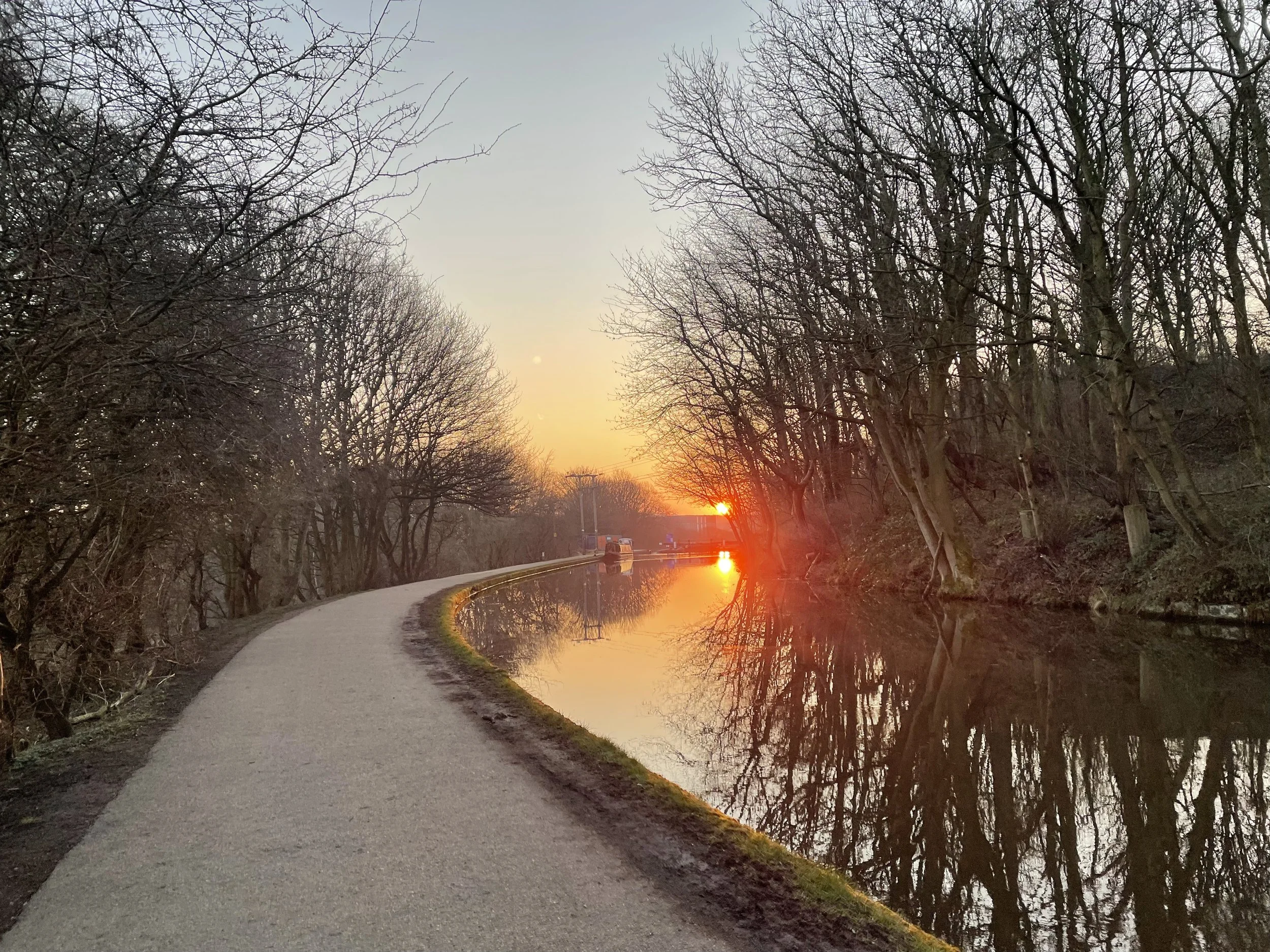
Winter sunrise on Leeds Liverpool Canal
Step Outside Immediately: Go outdoors within 30 to 60 minutes of waking. Do not simply look through a window. Window glass filters out critical blue-violet light wavelengths and reduces photon intensity by up to 50 times compared to outdoor ambient light.
Remove Barriers: Take off sunglasses and eyeglasses with strong UV filters (prescription contacts/glasses are fine). Do not look directly at the sun—simply face the general direction of the morning sky.
Dial In the Duration:
Clear Bright Days: 5 to 10 minutes.
Overcast / Cloudy Days: 15 to 20 minutes.
Heavy Cloud / Rainy Days: 20 to 30 minutes.
Stack Movement: Combine your photon intake with low-intensity movement—such as a 10-minute morning walk. The combination of optic flow (images moving past your eyes) and daylight exposure lowers anxiety centers in the brain (the amygdala) while resetting your clock.
4. COMMON FAULTS & CORRECTIONS
FAULT 1: Relying on Artificial Indoor Lighting.
Correction: Indoor home or office lights emit roughly 100 to 500 lux. Even on a cloudy morning, outdoor light delivers 10,000 to 20,000 lux. Step outside.
FAULT 2: Checking Your Smartphone Before Going Outside.
Correction: Looking at a screen indoors forces early ocular strain without providing sufficient lux to trigger the SCN's cortisol pulse. Get your daylight hit before engaging with digital inputs.
FAULT 3: Inconsistent Timing.
Correction: Getting morning light at 6:30 AM on weekdays and 11:00 AM on weekends creates "social jet lag." Maintain your wake and light-exposure window within a 60-minute variance every day.
5. SCALING OPTIONS
Dark Winter Mornings (High Latitudes): If you wake before dawn, use a certified 10,000 Lux Light Therapy Box or daylight simulator at eye level for 20 minutes upon waking, then step outside as soon as the sun rises.
Shift Workers: Execute your "morning light" protocol immediately upon waking from your primary sleep block, regardless of the chronological time of day, using high-intensity full-spectrum artificial light if sun is unavailable.