
Standing on one leg (flamingo)
Sitting for hours at a time is a slow trap. When you’re locked in an office chair all day, your hip flexors shorten, your glutes essentially go dark, and your nervous system loses its crisp ability to sense where your body is in space.
You don't need a barbell, a squat rack, or a track to undo the damage. Interjecting your workday with brief, intentional bursts of single-leg standing—the Unilateral Stance—acts as an instant hardware reset for your midline stability, joint alignment, and neurological firing.
Why Unilateral Balance Matters
This isn't just a quirky habit; balance is a high-demand, active physiological event. Holding yourself upright on one leg requires split-second coordination between your eyes, your inner ear (vestibular system), and your joints (proprioceptors),while your brain fires constant micro-corrections down the kinetic chain.
1. The 10-Second Mortality Predictor
A 12-year longitudinal study published in the British Journal of Sports Medicine (Araujo et al., 2022) tracked 1,702 adults aged 51 to 75. The findings were eye-opening: participants who couldn't balance unsupported on one leg for 10 seconds faced an 84% higher risk of all-cause mortality over the following decade compared to those who passed—even after adjusting for age, sex, and underlying health conditions. As highlighted in a feature by BBC Future, practising single-leg balance is one of the simplest, most effective movement habits to preserve longevity and physical autonomy as we age.
2. Microvascular & Brain Health Indicator
Research in the journal Stroke (Tabara et al., 2014) revealed that your balance is an early window into your brain's vascular health. Researchers discovered that struggling to stand on one leg for more than 20 seconds was strongly linked to cerebral small vessel disease—specifically silent micro-strokes (lacunar infarctions) and subclinical microbleeds in 34.5% of participants with multiple lesions. The takeaway: single-leg stability acts as a real-time visual check for neurocognitive and circulatory function.
3. Joint Stabilisation & Glute Activation
Physical therapist and mobility expert Dr Kelly Starrett (author of Deskbound and Built to Move) frequently highlights balance as a critical "movement vital sign." Sitting lulls the body into mechanical inefficiency, making us default to hanging off our joints rather than using active muscle. Standing on one foot forces the gluteus medius on the working side to fire instantly to keep your hips level. If that muscle slacks off, your hip drops (the Trendelenburg sign), dumping unwanted stress right into your lower back and knees. Single-leg standing forces active torque from your foot arch all the way up into your deep core stabilisers.
Movement Prescription: Points of Performance
Treat single-leg standing with the exact same focus and technical discipline you’d give a heavy pistol squat or deadlift. Execution drives adaptation.
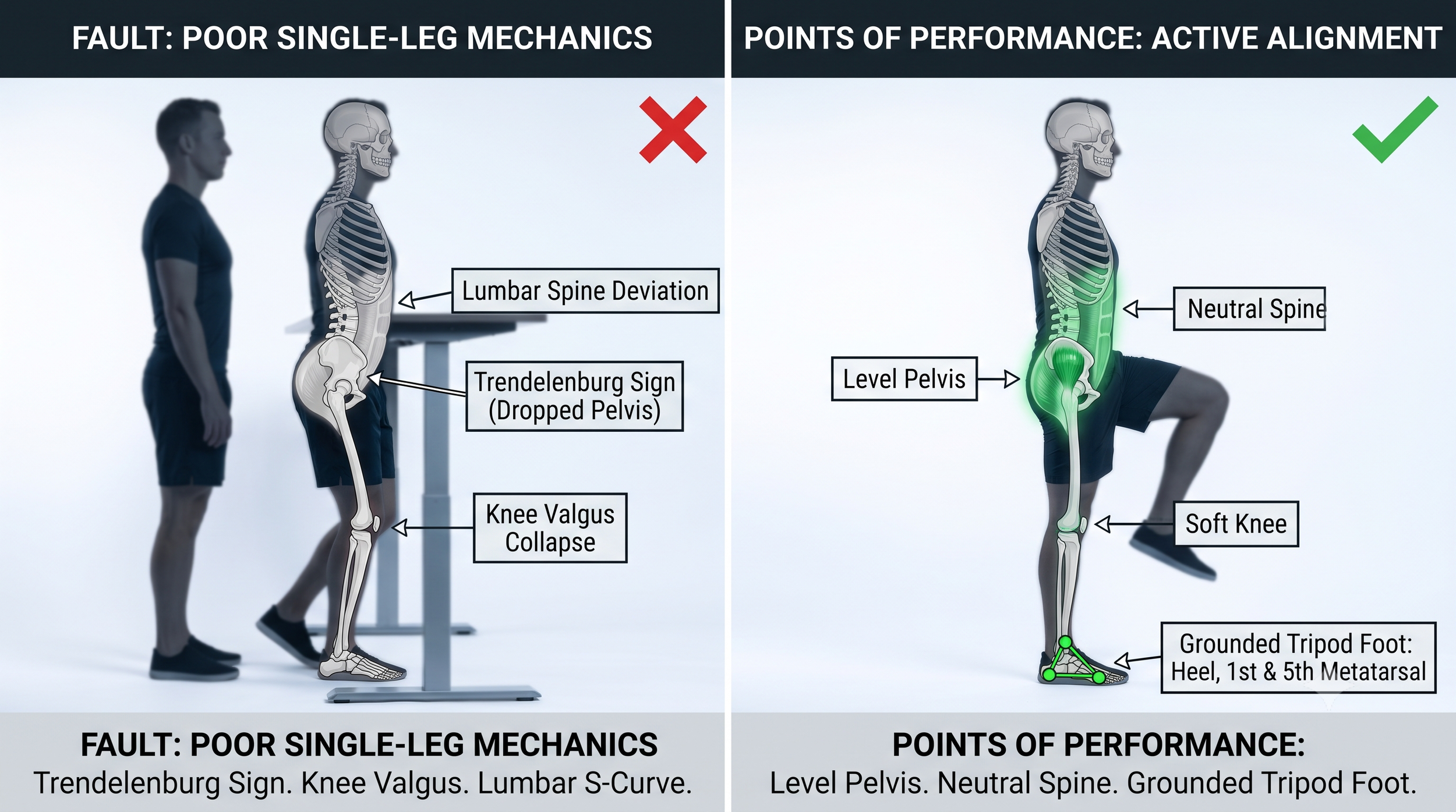
Standing on one leg isn’t as straight forward as you’d think!
Treat single-leg standing with the exact same focus and technical discipline you’d give a heavy pistol squat or deadlift. Execution drives adaptation.
1. Set the Base (The Tripod Foot)
Kick off your shoes if you can. Root into the floor by anchoring three key points: the ball of your big toe, the base of your pinky toe, and your heel. Spread your toes out to grip the floor.
2. Lock the Midline
Stand tall. Pull your rib cage down over your pelvis and tighten your abdominal wall as if you're preparing to take a punch. Draw your shoulders back and down away from your ears.
3. Elevate & Transfer Weight
Shift your weight smoothly onto your working leg without tilting your upper body sideways. Lift the off-leg cleanly, bringing your thigh up towards parallel (90 degrees at the hip) or hovering the foot just clear of the ground.
4. Squeeze the Standing Glute
Drive down through the centre of your standing foot and aggressively squeeze that glute. Keep both hip points completely level and square to the wall ahead of you.
5. Maintain a Soft Knee
Never lock out your knee bone-on-bone. Keep a subtle micro-bend (1–2 degrees) so your quads, hamstrings, and calves—not just your passive joint structures—do the work.
Common Faults & Corrections
The Workday Protocol
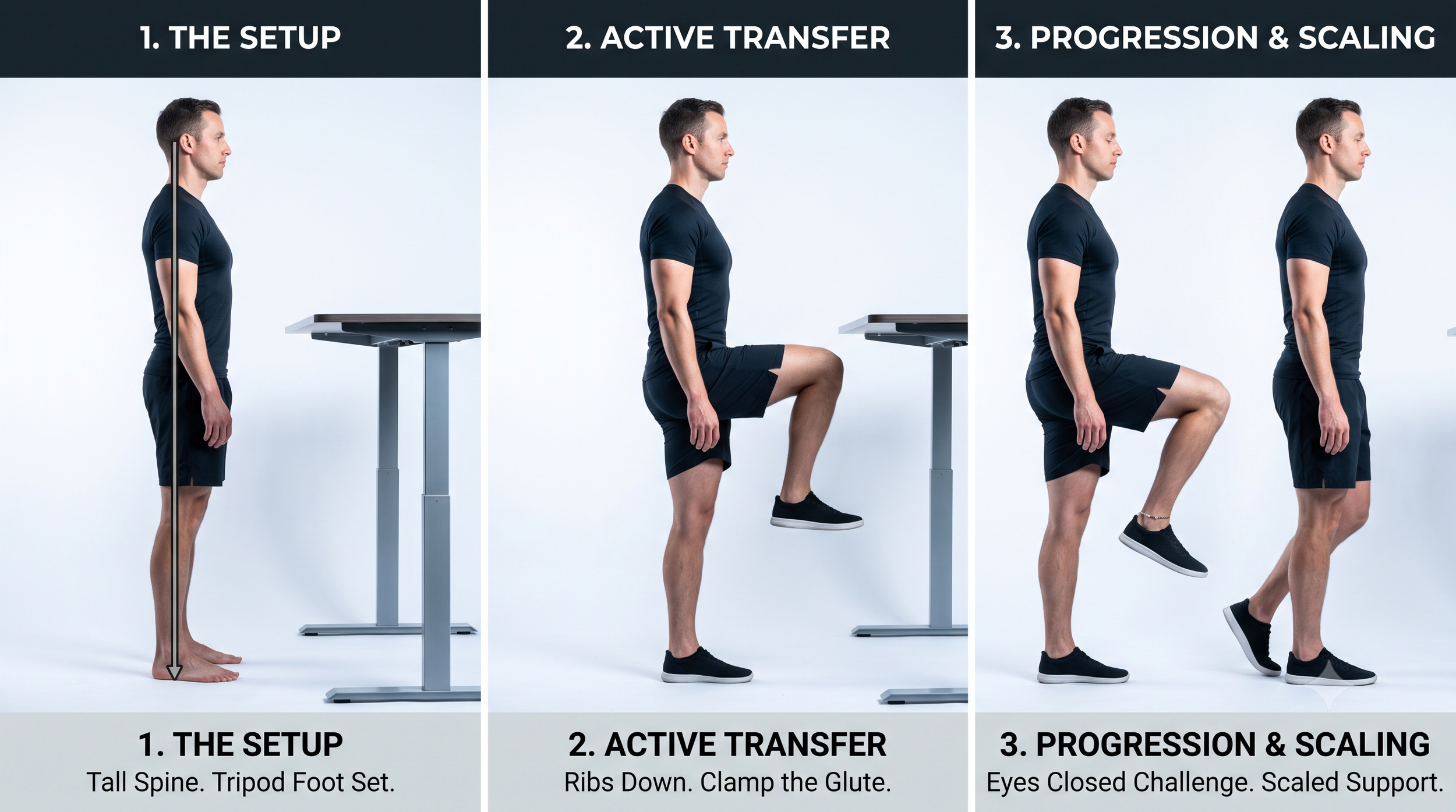
Good technique is key
Weave this drill directly into your regular work rhythm using an EMOM (Every Minute on the Minute) approach or micro-break structure.
Option A: The Hourly Micro-Reset (30/30)
At the top of every working hour, step away from your chair or pause your typing:
0:00–0:30: Hold on the Right Leg (Focus: Tripod foot & glute squeeze).
0:30–1:00: Hold on the Left Leg (Focus: Ribs down & chest tall).
Get back to work.
Option B: The Advanced Sensory Challenge (Eyes-Closed Drill)
Once you can rock a solid 45-second hold per leg with flawless form:
Perform 20 seconds per side with your eyes closed.
Safety Note: Shutting your eyes strips away visual cues, forcing your vestibular system and proprioceptors to carry 100% of the load. Keep a hand an centimetre away from your desk or wall so you're safe if you wobble.
References & Scientific Sources
Araujo, C. G., et al. (2022).Successful 10-second one-legged stance performance predicts survival in middle-aged and older individuals. British Journal of Sports Medicine, 56(17), 975–980.
Tabara, Y., et al. (2014).Association of postural instability with subclinical cerebrovascular lesions and cognitive decline. Stroke, 46(1), 16–22.
BBC Future (2026).The surprising health benefits of standing on one leg.
Starrett, K., & Starrett, J. (2023).Built to Move: 10 Essential Habits to Help You Move Freely and Live Fully.Knopf / The Ready State. (See also: Deskbound: Standing Up to a Sitting World, 2016).