
Couch Stretch Guide
Restoring Hip Extension in a Desk-Bound World
The Chair is an Adaptor
If you spend eight hours a day sitting at a desk, your body adapts to that environment. Human physiology follows a strict law of specificity: it adapts to the positions in which you spend the most time.
When seated, your hips remain locked in a 90-degree angle for hours on end. Over time, this chronic shortened position causes adaptive shortening of the anterior hip musculature. When you finally stand up, those tight tissues pull your pelvis forward into an anterior pelvic tilt, arching your lower back and switching off your glutes.
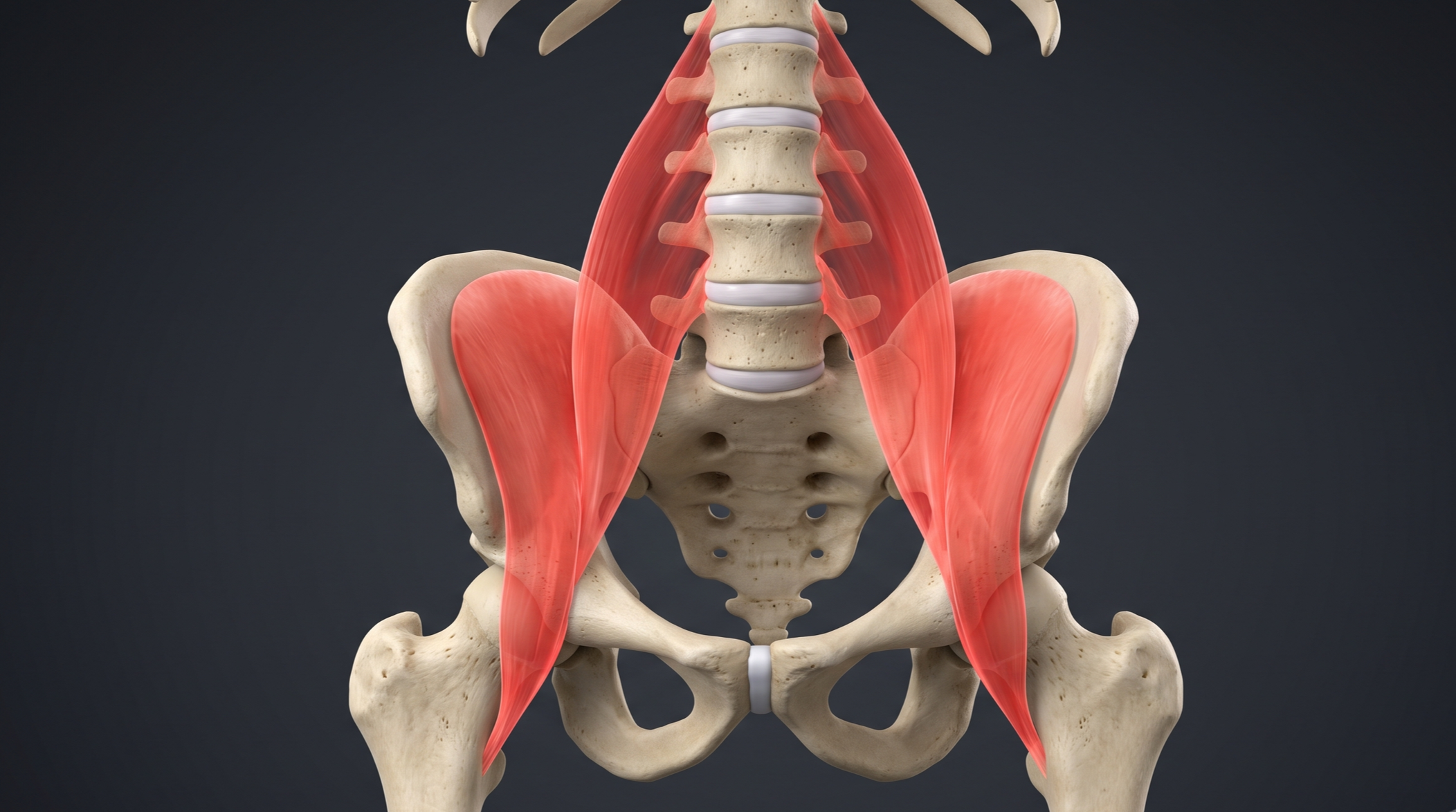
3D depiction of the psoas or ‘hip flexors’
Why Your Desk is Wrecking Your Hips
94.3% Prevalence: Research on sedentary individuals published in the International Journal for Multidisciplinary Research (IJFMR) revealed that 94.3% of participants exhibited significant hip flexor tightness directly correlated to extended sitting.
9.5 Hours Seated Daily: An investigation archived in PubMed Central highlights that adults average 9.5 hours of daily sedentary sitting. This persistent 90-degree flexion degrades passive hip extension range of motion.
Glute Inhibition: Research cited by the National Institutes of Health confirms that restricted hip flexor length causes neurological inhibition of the gluteus maximus. When your hip flexors will not open, your glutes cannot fire efficiently to extend your hips.
Low Back Dysfunction: Low back pain affects over 619 million people globally. Systematic reviews published on PubMed confirm that prolonged seated postures produce immediate, measurable increases in low back pain symptoms.
Anatomy Breakdown: The Psoas & Anterior Hip
To fix a mechanical error, you need to understand the mechanics.
The Psoas Major: The primary engine of hip flexion. It is the only muscle connecting your spine to your legs, attaching from your lower back (L1–L5) through the pelvis to the upper leg. When tightened, it pulls directly on your spine, inducing lower back strain.
The Iliacus: Sits on the inner bowl of your pelvis and joins the psoas tendon. Together, they are referred to as the iliopsoas.
The Rectus Femoris: The long quad muscle that crosses both the hip and knee joints. Sitting keeps it shortened at the hip; the couch stretch addresses both the hip flexor and quad simultaneously.
Popularised in modern mobility programming by physical therapist Dr Kelly Starrett (author of Becoming a Supple Leopard), the Couch Stretch is a targeted technique designed to un-stick these deep anterior structures, open the hips, and take strain off the spine.
The Standard: Executing the Couch Stretch
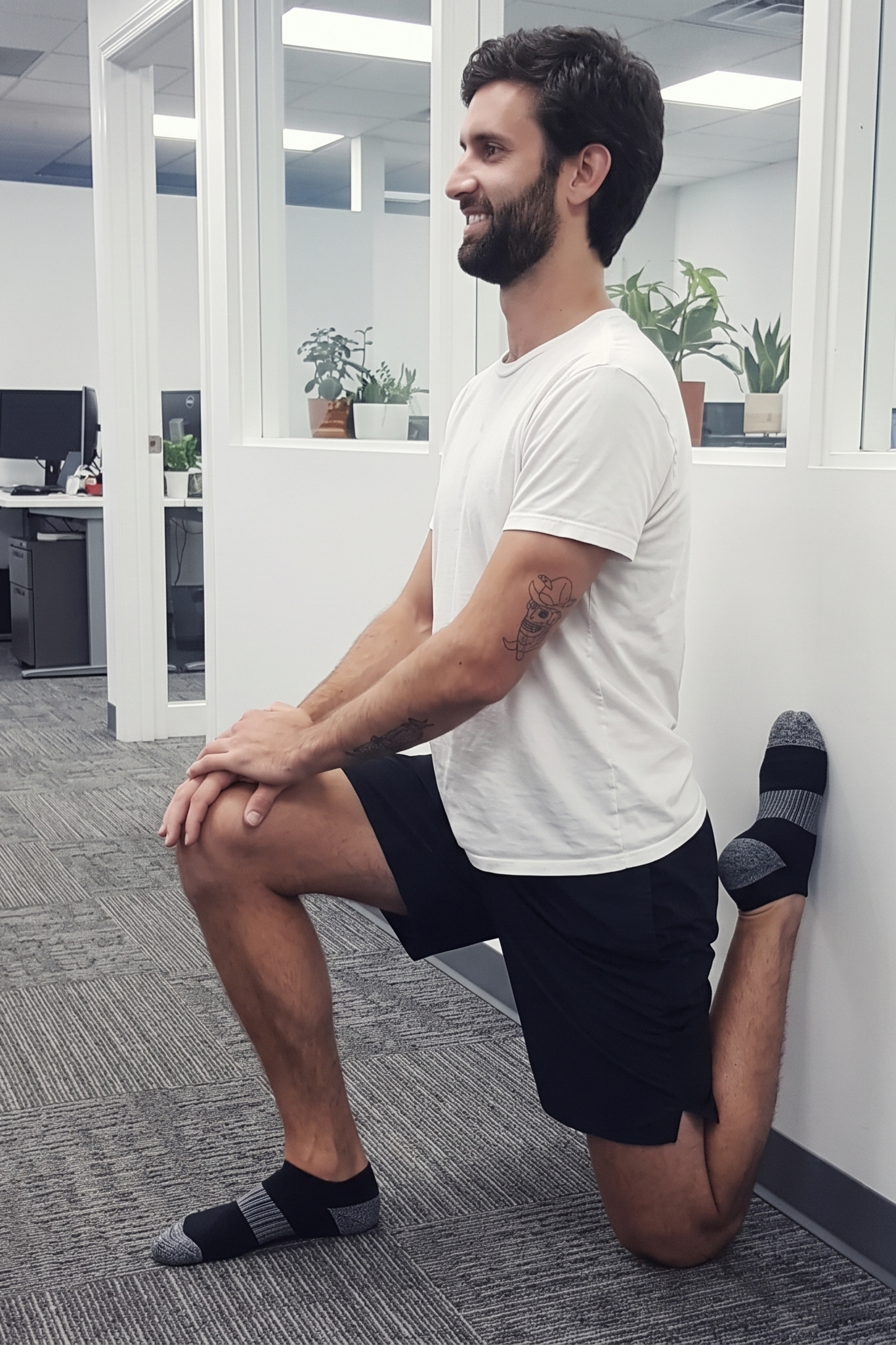
How to couch stretch
Set the Rear Knee (The Anchor)
Use a cushion, yoga mat, or folded towel under the knee
Back your feet up to a wall or office sofa. Slide your rear knee all the way into the corner where the floor meets the wall (or couch cushion). Position your rear shin flush against the wall with your toes pointing straight up.
Post the Front Foot
Establish a 90-degree base of support
Step your forward leg out in front of you, placing your front foot flat on the floor with your front knee stacked directly above your ankle.
Squeeze the Glute (Critical Point of Performance)
Do not arch your back to substitute for hip extension
Before raising your torso, contract the glute of your back leg forcefully. Squeezing the glute pushes the femur head forward in the hip socket and prevents your lumbar spine from hyper-extending.
Drive Torso Upright
2 to 3 minutes per side
Brace your core, maintain the glute squeeze, and bring your torso upright until your shoulder, hip, and rear knee form a vertical line. Breathe deeply. Hold for 2 to 3 minutes per leg during morning or afternoon workday breaks.
Office Progressions for Desk-Bound Novices
For those with severe hip tightness, jumping straight into a full wall couch stretch can be difficult. Use these scaled variations in an office setting:
Level 1: Half-Kneeling Chair-Supported Stretch (Beginner)
Setup: Stand next to your desk or a sturdy chair for balance. Step one leg back and drop into a low half-kneeling position on a padded cushion.
Focus: Keep your hips square. Tuck your tailbone slightly under (posterior pelvic tilt) and squeeze the rear glute.
Target: Opens up initial psoas stiffness without pinning the ankle against a wall.
Level 2: Desk-Supported Couch Stretch (Intermediate)
Setup: Place a foam pad or folded towel on the floor 12 inches away from a wall or desk chair. Place your back knee on the pad with your shin resting up against the chair or wall base.
Focus: Rest your hands on the edge of your desk or a foam roller for stability while elevating your torso.
Target: Gradual increase in quad and rectus femoris extension.
Level 3: Wall-Mounted Couch Stretch (Advanced)
Setup: Rear knee flush against the corner wall-floor joint, back shin flat against the wall, front leg posted forward, torso completely upright.
Focus: Maintain full abdominal bracing and glute contraction throughout.
| Point of Performance | Common Fault | Correction |
|---|---|---|
| Glute Squeeze | Loose glutes, leading to pelvic dumping. | Squeeze the rear buttock as hard as possible before elevating the torso. |
| Neutral Spine | Excessive arching in the lower back (lumbar hyper-extension). | Pull ribs down towards the pelvis, brace the midline, and limit torso elevation until mobility allows. |
| Front Shin Angle | Knee sliding past toes, heel lifting off the floor. | Walk the front foot forward until the shin is vertical and foot is flat. |
| Duration | Holding for 5–10 seconds. | Spend 2 to 3 full minutes per side. Biological tissue changes require long, continuous holds. |
For a visual demonstration of proper execution and positional cues, you can watch Dr Kelly Starrett's Couch Stretch Technique Guide. This video provides a direct, practical walkthrough of how to set up the stretch, engage your glutes, and open up locked hip flexors effectively.